
The Department of Health advises that on average, the flu vaccination can reduce an employee’s risk of contracting the flu by approximately 60%, (based on a recent systematic review). The flu can last for a week or more with individuals suffering fatigue for up to three weeks. Ramsay Pharmacy’s corporate flu vaccination service provides your team with the greatest protection available to reduce the risk of influenza affecting your workplace this flu season. The more people that are vaccinated in a workplace, the less chance the flu has of spreading which helps reduce absenteeism and presenteeism.
As part of Ramsay Health Care, our Ramsay Pharmacies will take good care of your team.
Conveniently located across NSW, VIC and QLD, our pharmacies have qualified Pharmacist Immunisers ready to help your team fight the flu this season and to help your workplace remain strong and healthy.
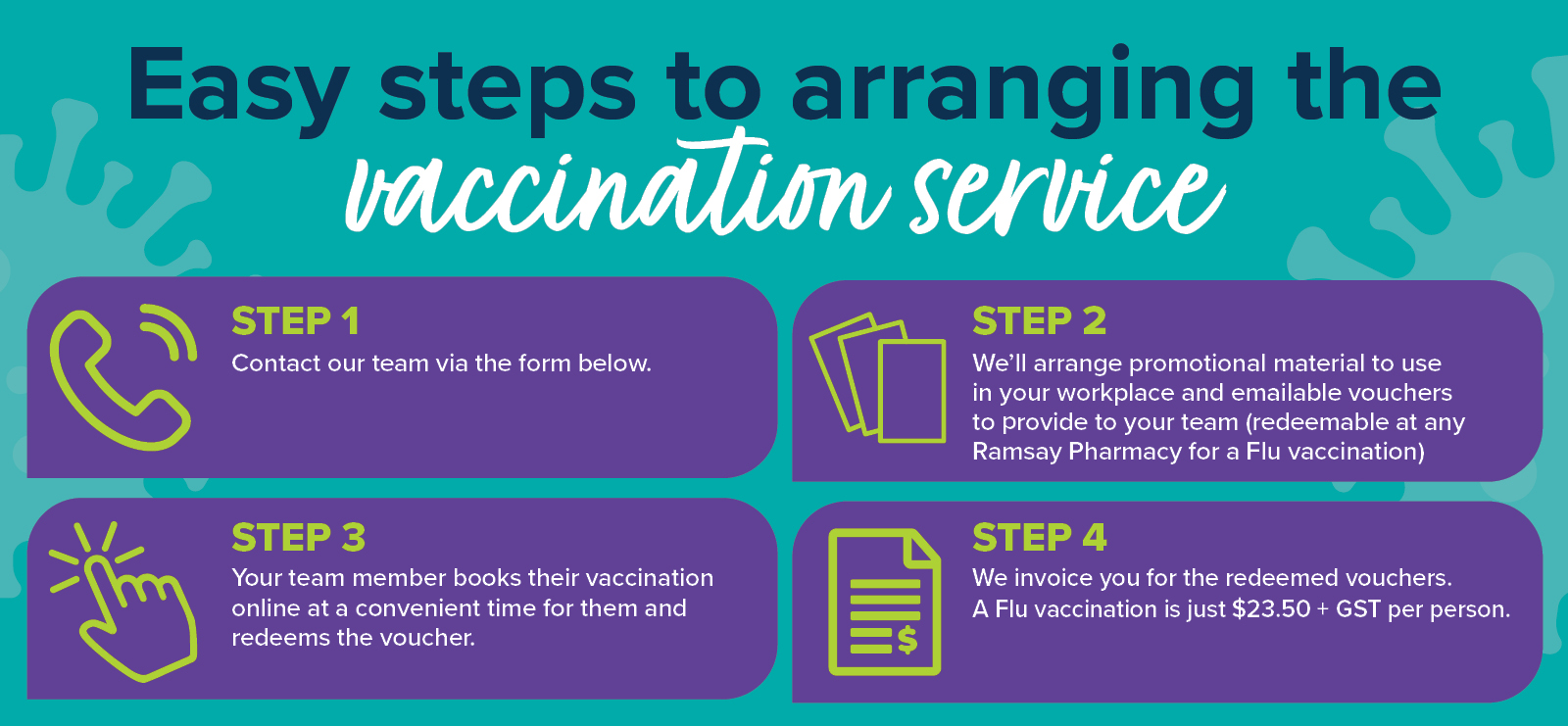
Contact us via the form below and a team member will be in touch.
Contact us via the form below and a team member will be in touch.
FAQs
The Australian Government recommends that everyone over the age of 6 months has a flu vaccine every year.
It’s difficult to predict who will catch the flu, or who will become seriously ill from it. The flu can
require someone to be hospitalised and it can even be fatal.
Getting vaccinated against the flu helps protect both you and the people around you. It’s particularly
important to protect vulnerable people in the community who can’t be vaccinated, such as babies who are
younger than 6 months and adults with low immunity.
For most people, the best time to have your flu vaccine is from April onwards, so that you have had your
vaccine before the start of the peak flu season. The protection from the flu vaccine starts to decline
after 3-4 months, so having your flu vaccine in April means that you still have optimal protection during
the peak June-August flu season. However, you may need to have your flu vaccine earlier for other reasons
e.g. travel or work purposes, so talk to your Ramsay Pharmacist about the best time to have your flu
vaccine. In any case – it’s never too late to vaccinate!
No. All flu vaccines used in Australia are ‘inactivated’, which means they do not contain the live flu
virus and so you can't catch the flu from the vaccine.
Around 1 in 3 people may have some mild tenderness around the injection site, and around 1 in 6 people may experience mild muscle ache, headache and/or tiredness. These side effects can start within a few hours of your being vaccinated and sometimes last for 1 or 2 days. They usually go away on their own, once your body has developed an immune response to the vaccine, which will protect you from the flu virus.
It’s important to remember that the side effects show the vaccine is triggering an immune response, which is what it’s designed to do.
- The influenza vaccine is very safe.
- Vaccination is a safe and effective way to protect you from serious disease caused by influenza
- Annual vaccination is the most important measure to prevent influenza and its complications. It is
recommended for all people >= 6 months of age. It is particularly important for those most at
risk.
- Influenza vaccine is safe to give during any stage of pregnancy or while breastfeeding for both
the mother and her baby. Several systematic reviews have shown no association between influenza
vaccination in pregnancy and adverse birth outcomes
- The chance of experiencing a serious problem from having a vaccine is far lower than the risk
of serious harm from catching influenza.
- Vaccination is a safe and effective way to protect you from serious disease caused by influenza.
Influenza affects people of all ages but is especially serious for young babies, young children,
pregnant women and people with underlying medical conditions. It can require hospitalisation and
cause death
- You may experience minor side effects following vaccination. Most reactions are mild and last no
more than a couple of days and you will recover without any problems
-
Serious side effects, such as a severe allergic reaction are extremely rare
- The vaccine doesn’t contain any live virus, so you can’t get the flu from being
vaccinated.
- While some effects may seem like influenza, none of the influenza vaccines available in Australia
contain live influenza viruses, so they cannot cause influenza.
Flu vaccination prevents illness in 5 or 6 out of 10 healthy adults under the age of 65. Because the
vaccine is not effective in absolutely every case, some people may still catch the virus after having the
flu vaccine, but the risk of illness is still reduced.
Although most people who get the flu recover without lasting effects, the flu can be very serious in some
people and may require them to be hospitalised. In some cases, it can even be fatal. Vaccination against
the flu reduces your chances of getting it and may reduce the severity of the symptoms, so it is still
important to have the shot.
Feeling cold doesn't cause the flu (or the common cold). The only way to catch influenza is to be exposed
to the virus, via tiny droplets of mucus that are coughed or sneezed into the air or transmitted through
touch.
Cold and flu season does happen to coincide with the colder months. Wintry weather forces people indoors
more often — where they're more likely to be in close proximity with infectious people.
You need a flu vaccination each year as the flu virus frequently changes. The flu vaccine is updated
every year according to the most common strains likely to affect Australia during the winter season. The
benefit of the flu vaccine tends to wear off after three to four months.
Previous quadrivalent (four-strain) flu vaccines contained a B/Yamagata lineage virus. However, since March 2020 - the start of the pandemic - this strain has not been detected in natural circulation. This may be due to the social distancing, handwashing and other infection control measures at the time being extremely effective.
In 2023, the World Health Organization has recommended that B/Yamagata no longer be included in flu vaccines, as there is a theoretical risk of reintroducing this strain into public circulation. In 2026, Australia has adopted this recommendation.
The three strains included in Australian egg-based and cell-based flu vaccines mirror WHO recommendations.
Reference:
https://cdn.who.int/media/docs/default-source/influenza/who-influenza-recommendations/vcm-sh-2025/b.-26-september-2025-frequently-asked-questions.pdf?sfvrsn=eb94f684_6
Egg-based vaccines are manufactured using a different production system to cell-based vaccines, and influenza viruses may not reproduce equally well in egg- and cell-based systems. Different viruses with similar properties are sometimes recommended for each system to help bring vaccines to market in time for the Australian peak flu season.
For the 2026 flu season, Ramsay Pharmacy will be using a cell-based vaccine for people aged between 6 months and 64 years, rather than a ‘traditional’ egg-based vaccine. Cell-based vaccines have no egg content at all and can be confidently given to people who have an egg allergy.
For people aged 65 years and over, a different (adjuvanted) flu vaccine has been shown to be more effective and is recommended by the Australian Government Department of Health. Adjuvanted flu vaccine is grown in eggs. However, the amount of egg protein that remains after the vaccine is made is so tiny that the Australasian Society of Clinical Immunology and Allergy (ASCIA) advises that people with egg allergy can be safely vaccinated using an egg-based vaccine. The risk of anaphylaxis in response to the vaccine is very low, estimated at 1.35 cases per 1 million doses.
The flu vaccine won’t protect you against COVID-19 (coronavirus), but it will reduce your risk of
influenza — which leads to thousands of hospitalisations each year. By getting the flu vaccine, you can
reduce the strain on the health service.
Yes, the flu vaccine and the covid-19 vaccine can both be given on the same day.
A new intranasal (nasal spray) flu vaccine has been approved for use in Australia, and is available through state government funded programs in NSW and QLD.
In NSW, this vaccine is free of charge for children aged 2, 3 and 4 years only.
In QLD, this vaccine is free of charge for children aged 2, 3, 4 and 5 years only.
Flu vaccination rates for children aged under 5 are low, and the availability of a new needle-free flu vaccine can make vaccination a smoother experience for everyone.
The intranasal flu vaccine has been shown to be as effective as the injectable flu vaccine, and is absorbed quickly through the sinus lining. This means that it will still work even if your child sneezes afterwards.
The National Immunisation Program provides government-funded vaccines for those most at risk, including: children aged 6 months-<5 years; pregnant women at any stage of pregnancy; First Nations people aged 6 months and over; people aged 65 years and older; people with certain medical risk factors.
Your Ramsay Pharmacist can vaccinate under the National Immunisation Program free of charge (fully government funded).
*Administered by a qualified Pharmacist. Age restrictions do apply and some persons may be eligible for a free vaccine, see FAQs for details Please allow 15 minute post-vaccination for monitoring. Walk in appointments are subject to availability. Bookings for children under 16 years require parent/guardian consent. Must be a Ramsay Pharmacy better rewards member to receive member pricing, visit https://www.ramsaypharmacy.com.au/Rewards to find out more. QLD flu vaccinations are funded by the QLD government.